The Keys’ other marker system.
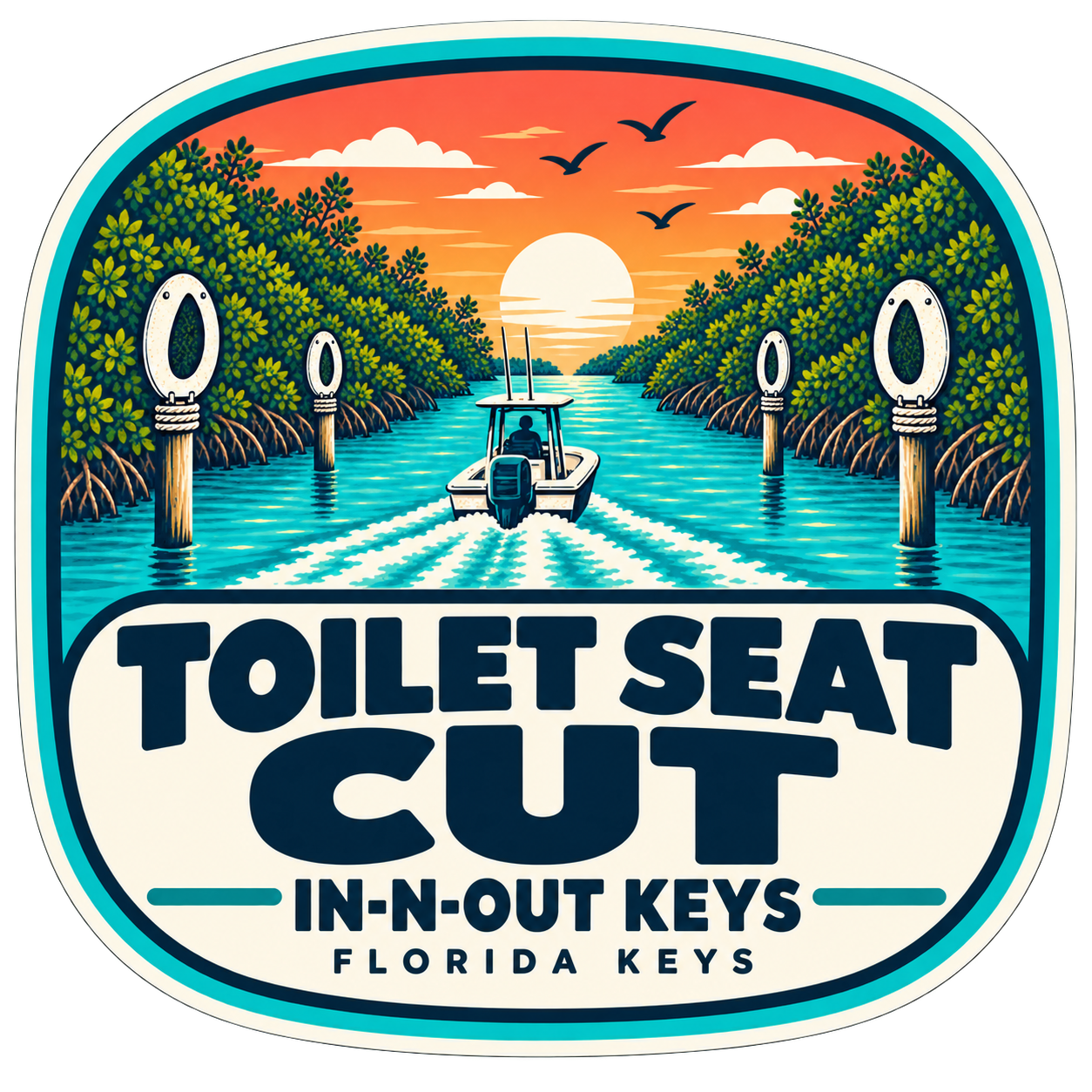
Off Plantation Key there is a channel marked with 250 toilet seats. It started with one man, one shortcut, and one hurricane.
Post 01 was about the Keys’ official marker system — the green signs that turned a wrecked railroad into an address. This one is about the unofficial system. It sits in Florida Bay off Plantation Key, it is roughly 250 toilet seats long, and technically none of it is supposed to be there.
A man who was tired of the long way round
In 1956 a Miami architect named Vernon D. Lamp built a second home in the Plantation Key Colony neighborhood, up around Mile Marker 90. He was a serious fisherman and a member of the Miami Rod and Reel Club, and he had a problem that anyone who has run a boat on the bayside will recognize immediately.
Three miles south of him, at Mile Marker 87, sat Plantation Yacht Harbor — the popular waterfront spot of the day, on the site of what is now Founders Park. Three miles as the crow flies. But the water between his house and the bar was a shallow seagrass flat, too thin to run a boat across. Getting there meant motoring out into Florida Bay, finding water deep enough to operate in, coming back inshore, and burning fifteen or twenty minutes doing it.
Lamp decided he would rather have a shortcut.
The Bucktail
He bolted a 50-horsepower motor onto his boat, a vessel named Bucktail, and used the prop wash to blow a trench through the grass flat. Not in an afternoon. He worked at it until he had a channel four to six feet wide — enough for a johnboat or a flats skiff to slip through — running straight between the two ends of the trip he kept making.
Then he drove posts into the marl at either end so he could find his own channel again.
It is worth saying plainly that nobody could do this today. Dredging a seagrass bed with a boat motor was something a man could get away with in the 1950s and would end very differently now. The protections that exist for those flats exist for good reasons.
September 1960
Hurricane Donna came through the Keys as a Category 4 and did what those storms do. It is credited with more than 150 deaths, and it took houses apart across the Upper Keys.
When it cleared, Lamp went out to check on his shortcut. One of his marker posts had a nail sticking out of it. Hanging on the nail, delivered by a hundred-plus mile an hour wind out of somebody’s wrecked bathroom, was the rim of a toilet seat.
He took it home, cleaned it up, painted it, and hung it back on the same post.
That is the entire origin of the thing. One man with a sense of humor deciding that the storm had made a suggestion worth taking.
Everybody else joined in
Locals saw what he had done and started adding their own. A seat went up for a wedding. Then birthdays, anniversaries, family reunions, spring break, and eventually no occasion at all. One longtime resident remembers seats already hanging out there in 1967.
The channel today runs about sixty feet wide with somewhere around 250 decorated seats lining both sides, painted with names and dates and jokes. There is a five-foot pirate planted in the marl, and a mailbox. People kayak out from Tavernier Creek specifically to look at it.
The part where everyone agrees to look away
None of it is permitted. The seats and the PVC poles function as channel markers, and a 1998 channel marking plan for the Florida Keys described them in exactly that bureaucratic register: unpermitted.
Removing them was considered. The plan noted that taking away the decorated markers would most likely outrage local boaters, and that was apparently the end of the discussion. A federal planning document looked directly at 250 illegal toilet seats and concluded that the wiser course was to leave them alone.
That is about as Keys as a sentence gets.
How anyone found out
For decades nobody could tell you where it started. Forty-year residents of the Upper Keys had no idea. The story only surfaced when Lamp’s daughter, Cheryl, called to explain what her father had done, and a longtime Keys family confirmed it.
So a landmark that thousands of people photograph every year was an unsolved mystery until someone’s kid picked up the phone.
Where to find it
Bayside off Plantation Key, out around Mile Marker 90, running parallel to Cowpens Cut. Boat or kayak only — there is no version of this you can see from US-1. Paddlers usually launch at Tavernier Creek and hug the shoreline.
If you go, go carefully. It is still a seagrass flat, and the thing that makes the story funny is also the thing that would get you a serious fine if you tried to repeat it.
We run past Islamorada every week hauling cars up and down the Overseas Highway, and a couple of miles off the road there is a channel that exists because one man in 1956 did not feel like taking the long way to a bar. The Keys are full of that. Most of it never makes it onto a sign.
Nearby on the chain
Toilet Seat Cut sits bayside off Plantation Key, a few miles north of the Islamorada stops we run every week. Shipping a car to Islamorada?
In-N-Out Keys, LLC (USDOT 4120018), doing business as Florida Keys Auto Transport, is a veteran-owned Florida motor carrier operating under Florida intrastate authority. Moves outside Florida are handled by trusted partner carriers.
Shipping a car down the chain?
We run the whole road, MM 0 to MM 100. Tell us both ends and we’ll price it.
Get your free quoteor call & text (754) 714-2439